Buy hrcafe.eu ?
We are moving the project
hrcafe.eu .
Are you interested in purchasing the domain
hrcafe.eu ?
domain@kv-gmbh.de · 0541-91531010
Buy hrcafe.eu ?
What are harmonic oscillations?
Harmonic oscillations are repetitive back-and-forth movements or vibrations that follow a specific pattern. They are characterized by a sinusoidal or wave-like motion, where the displacement of the oscillating object from its equilibrium position is proportional to the restoring force acting on it. Examples of harmonic oscillations include the swinging of a pendulum, the motion of a mass-spring system, and the vibrations of a guitar string. These oscillations are important in many areas of physics and engineering, as they can be used to describe and analyze various natural and mechanical systems. **
How do you draw oscillations?
To draw oscillations, you can start by plotting a sinusoidal function on a graph. The function can be in the form of y = A*sin(Bx + C) or y = A*cos(Bx + C), where A is the amplitude, B is the frequency, and C is the phase shift. You can then plot the points on the graph by plugging in different values of x to see how the function oscillates. Additionally, you can use a ruler to connect the points to create a smooth oscillation curve. **


Similar search terms for Oscillations
Top-Angebote
Products related to Oscillations:
-
Uplifted Finds Predatory Engagement Wrestling Puppet Hub Predatory Engagement Wrestling Puppet HubTransform interactive play with the PredatoryEngagement Puppet, a professionalgrade interaction module engineered with manualsimulation logic. This highutility tool features a reinforced plush architecture and poseable limbs, specifically designed...85,97 $*Shipping: 0,00 $Secure redirect to the provider
-
DEVERA 6-Door Employee Storage Metal Locker for OfficeHighlights Ample Storage & Organization: Featuring six large compartments, this employee locker provides generous space for individualized storage. Suitable for various settings, including schools, homes, restaurants, garages, locker rooms, and dorms.259,99 $*Shipping: 0,00 $Secure redirect to the provider
-
Inspire Select Interactive Training Card Set Observation, Logic & Thinking Skill Development Puzzle Cards For Kids intermediateIntroduction Help young minds develop stronger focus, reasoning, and creativity with this engaging training card set designed for handson learning. Each card features fun, interactive challenges that build observation, memory, and problemsolving...40,98 $*Shipping: 0,00 $Secure redirect to the provider
-
Uplifted Finds Octo Plush High Engagement Stimulator colorfulInject highintensity excitement into your pets day with the OctoPlush Stimulator, a multisensory toy engineered with tentacleflutter logic. Designed to mimic the erratic movement of aquatic prey, this 18 cm toy utilizes multistrand kinetic...33,97 $*Shipping: 0,00 $Secure redirect to the provider




-
How do damped oscillations work?
Damped oscillations occur when an external force or frictional resistance acts upon a vibrating system, causing the amplitude of the oscillations to decrease over time. This damping effect gradually reduces the energy of the system, resulting in the oscillations eventually coming to a stop. The rate at which the oscillations decay is determined by the damping coefficient, with higher damping leading to faster decay. Damped oscillations are commonly observed in various systems, such as springs and pendulums, where energy is gradually dissipated due to external factors. **
-
What are resonance-driven oscillations?
Resonance-driven oscillations occur when a system is subjected to an external force at its natural frequency, causing it to oscillate with increasing amplitude. This phenomenon is known as resonance, where the energy of the external force is transferred efficiently to the system, leading to large oscillations. Resonance-driven oscillations can be observed in various systems, such as mechanical, electrical, and acoustic systems, and are important in understanding the behavior of these systems under different conditions. **
-
What are examples of damped oscillations?
Examples of damped oscillations include a swinging pendulum in a viscous fluid, a car's suspension system responding to bumps on the road, and the motion of a spring-mass system with air resistance. In each case, the oscillations gradually decrease in amplitude over time due to the dissipative forces present, such as friction or air resistance. The damping effect causes the system to eventually come to rest at its equilibrium position. **
-
How can sinusoidal oscillations be modeled?
Sinusoidal oscillations can be modeled using mathematical equations that describe the amplitude, frequency, and phase of the oscillation. The most common way to model sinusoidal oscillations is through a sine or cosine function, such as y = A*sin(2πft + φ), where A is the amplitude, f is the frequency, t is the time, and φ is the phase shift. By adjusting these parameters, we can accurately represent the behavior of sinusoidal oscillations in various systems and phenomena. Additionally, sinusoidal oscillations can also be modeled using differential equations in the context of dynamic systems analysis. **

What are the trigonometric functions in oscillations?
In oscillations, the trigonometric functions commonly used are sine and cosine functions. These functions describe the relationship between the angle of rotation and the position of an object undergoing oscillatory motion. The sine function represents the vertical component of the motion, while the cosine function represents the horizontal component. By using these trigonometric functions, we can analyze and predict the behavior of oscillatory systems. **
Does a wave consist of multiple oscillations?
Yes, a wave consists of multiple oscillations. In physics, a wave is a disturbance that travels through a medium, transferring energy without transferring matter. This disturbance causes particles in the medium to oscillate back and forth, creating a pattern of repeated motion. Therefore, a wave is made up of multiple oscillations as it propagates through the medium. **
Top-Angebote
Products related to Oscillations:
-
Anker Plus Member BenefitsShipping Service Free Next-Day Shipping (1 Item per Month) Free Express Shipping (1 Item per Month) AnkerCredits Rewards Earn 1.5 AnkerCredits for Every $1 Spent (Upgraded Benefit) Access Exclusive Redemption Products Warranty Extra 6-month extended...99,99 $*Shipping: 0,00 $Secure redirect to the provider
-
DEVERA 9-Door Employee Storage Metal LockerHighlights Ample Storage & Organization: Featuring 9 large compartments, this employee locker provides generous space for individualized storage. Suitable for various settings, including schools, homes, restaurants, garages, locker rooms, and dorms.288,57 $*Shipping: 0,00 $Secure redirect to the provider
-
Uplifted Finds Predatory Engagement Wrestling Puppet Hub Predatory Engagement Wrestling Puppet HubTransform interactive play with the PredatoryEngagement Puppet, a professionalgrade interaction module engineered with manualsimulation logic. This highutility tool features a reinforced plush architecture and poseable limbs, specifically designed...85,97 $*Shipping: 0,00 $Secure redirect to the provider
-
DEVERA 6-Door Employee Storage Metal Locker for OfficeHighlights Ample Storage & Organization: Featuring six large compartments, this employee locker provides generous space for individualized storage. Suitable for various settings, including schools, homes, restaurants, garages, locker rooms, and dorms.259,99 $*Shipping: 0,00 $Secure redirect to the provider
-
What are harmonic oscillations?
Harmonic oscillations are repetitive back-and-forth movements or vibrations that follow a specific pattern. They are characterized by a sinusoidal or wave-like motion, where the displacement of the oscillating object from its equilibrium position is proportional to the restoring force acting on it. Examples of harmonic oscillations include the swinging of a pendulum, the motion of a mass-spring system, and the vibrations of a guitar string. These oscillations are important in many areas of physics and engineering, as they can be used to describe and analyze various natural and mechanical systems. **
-
How do you draw oscillations?
To draw oscillations, you can start by plotting a sinusoidal function on a graph. The function can be in the form of y = A*sin(Bx + C) or y = A*cos(Bx + C), where A is the amplitude, B is the frequency, and C is the phase shift. You can then plot the points on the graph by plugging in different values of x to see how the function oscillates. Additionally, you can use a ruler to connect the points to create a smooth oscillation curve. **
-
How do damped oscillations work?
Damped oscillations occur when an external force or frictional resistance acts upon a vibrating system, causing the amplitude of the oscillations to decrease over time. This damping effect gradually reduces the energy of the system, resulting in the oscillations eventually coming to a stop. The rate at which the oscillations decay is determined by the damping coefficient, with higher damping leading to faster decay. Damped oscillations are commonly observed in various systems, such as springs and pendulums, where energy is gradually dissipated due to external factors. **
-
What are resonance-driven oscillations?
Resonance-driven oscillations occur when a system is subjected to an external force at its natural frequency, causing it to oscillate with increasing amplitude. This phenomenon is known as resonance, where the energy of the external force is transferred efficiently to the system, leading to large oscillations. Resonance-driven oscillations can be observed in various systems, such as mechanical, electrical, and acoustic systems, and are important in understanding the behavior of these systems under different conditions. **
Similar search terms for Oscillations
-
Inspire Select Interactive Training Card Set Observation, Logic & Thinking Skill Development Puzzle Cards For Kids intermediateIntroduction Help young minds develop stronger focus, reasoning, and creativity with this engaging training card set designed for handson learning. Each card features fun, interactive challenges that build observation, memory, and problemsolving...40,98 $*Shipping: 0,00 $Secure redirect to the provider
-
Uplifted Finds Octo Plush High Engagement Stimulator colorfulInject highintensity excitement into your pets day with the OctoPlush Stimulator, a multisensory toy engineered with tentacleflutter logic. Designed to mimic the erratic movement of aquatic prey, this 18 cm toy utilizes multistrand kinetic...33,97 $*Shipping: 0,00 $Secure redirect to the provider
-
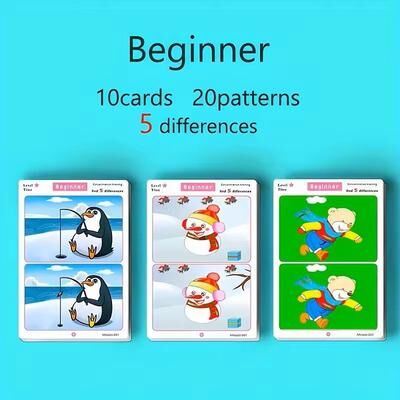
Inspire Select Interactive Training Card Set Observation, Logic & Thinking Skill Development Puzzle Cards For Kids beginnerIntroduction Help young minds develop stronger focus, reasoning, and creativity with this engaging training card set designed for handson learning. Each card features fun, interactive challenges that build observation, memory, and problemsolving...39,98 $*Shipping: 0,00 $Secure redirect to the provider
-
Inspire Select Interactive Training Card Set Observation, Logic & Thinking Skill Development Puzzle Cards For Kids advancedIntroduction Help young minds develop stronger focus, reasoning, and creativity with this engaging training card set designed for handson learning. Each card features fun, interactive challenges that build observation, memory, and problemsolving...40,98 $*Shipping: 0,00 $Secure redirect to the provider
-
What are examples of damped oscillations?
Examples of damped oscillations include a swinging pendulum in a viscous fluid, a car's suspension system responding to bumps on the road, and the motion of a spring-mass system with air resistance. In each case, the oscillations gradually decrease in amplitude over time due to the dissipative forces present, such as friction or air resistance. The damping effect causes the system to eventually come to rest at its equilibrium position. **
-
How can sinusoidal oscillations be modeled?
Sinusoidal oscillations can be modeled using mathematical equations that describe the amplitude, frequency, and phase of the oscillation. The most common way to model sinusoidal oscillations is through a sine or cosine function, such as y = A*sin(2πft + φ), where A is the amplitude, f is the frequency, t is the time, and φ is the phase shift. By adjusting these parameters, we can accurately represent the behavior of sinusoidal oscillations in various systems and phenomena. Additionally, sinusoidal oscillations can also be modeled using differential equations in the context of dynamic systems analysis. **
-
What are the trigonometric functions in oscillations?
In oscillations, the trigonometric functions commonly used are sine and cosine functions. These functions describe the relationship between the angle of rotation and the position of an object undergoing oscillatory motion. The sine function represents the vertical component of the motion, while the cosine function represents the horizontal component. By using these trigonometric functions, we can analyze and predict the behavior of oscillatory systems. **
-
Does a wave consist of multiple oscillations?
Yes, a wave consists of multiple oscillations. In physics, a wave is a disturbance that travels through a medium, transferring energy without transferring matter. This disturbance causes particles in the medium to oscillate back and forth, creating a pattern of repeated motion. Therefore, a wave is made up of multiple oscillations as it propagates through the medium. **
* All prices are inclusive of VAT and, if applicable, plus shipping costs. The offer information is based on the details provided by the respective shop and is updated through automated processes. Real-time updates do not occur, so deviations can occur in individual cases. ** Note: Parts of this content were created by AI.